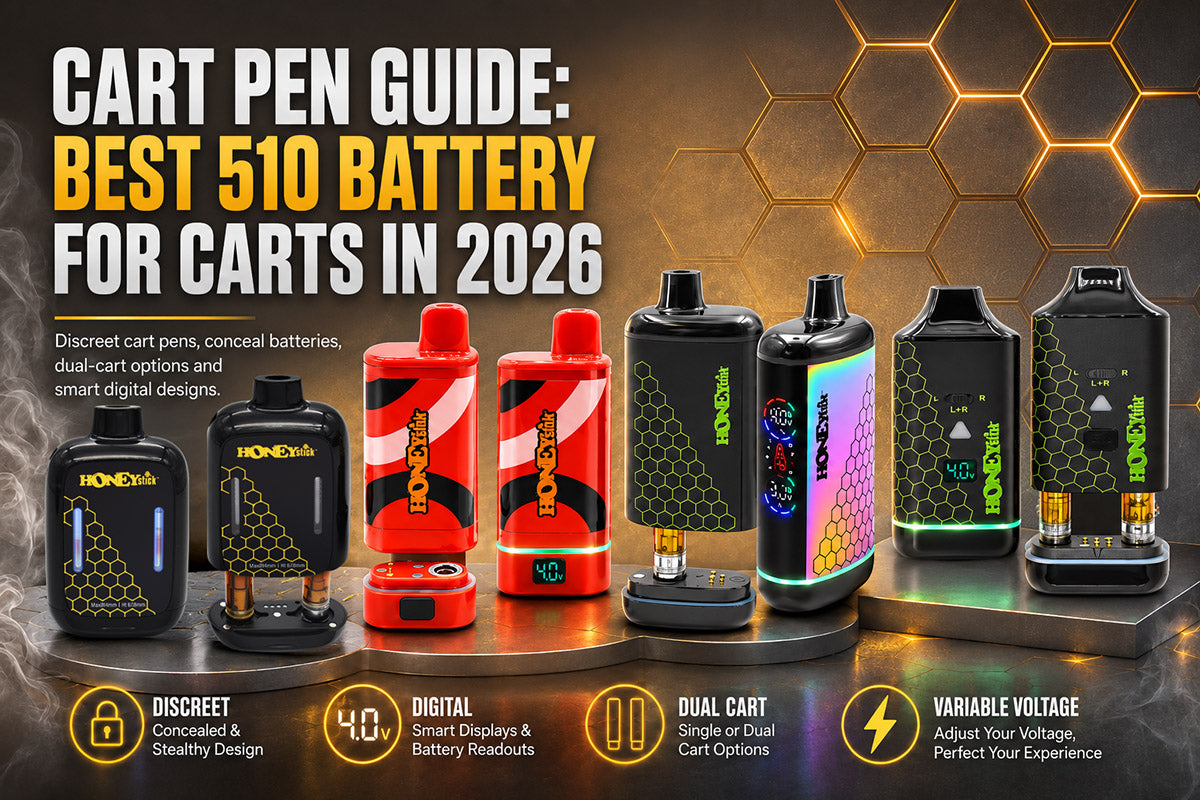
If you have searched for a “Cart Pen” online, you have likely seen a flood of dispensary pages selling cartridges. But what about the battery that powers it? The term gets thrown around loosely, and that creates confusion. A Cart Battery is not a single disposable unit. It is a system: a 510 thread cartridge filled with oil, screwed onto a rechargeable battery. The cartridge is the consumable. The battery is the reusable hardware.
This guide focuses on the hardware side of the equation, specifically the kind of discreet, pen-shaped battery that lets you vape without drawing attention. By the time you finish reading, you will understand exactly what to look for in a 510 battery, how to use it properly, and why the right device makes all the difference.
Table of Contents
- What Is a Cart Pen? (And Why the Battery Matters More Than You Think)
- How Much Does a Cart Battery Cost? (Pricing and Value in 2026)
- Distillate vs. Live Resin vs. Live Rosin: Which Weed Cartridge Works Best For You?
- How to Use a Cartridge Battery for the First Time (Beginner’s Guide)
- How to Fix Common 510 Cart Battery Problems (Troubleshooting and Maintenance)
- What Are the Best Cart Pens in 2026? (Key Features to Look For)
- Frequently Asked Questions About Cartridge Vape Pens
- Conclusion: Choose the Right 510 Cart Battery for Your Lifestyle
What Is a Cart Pen? (And Why the Battery Matters More Than You Think)
A Cart Pen is the combination of a pre-filled 510 thread cannabis oil cartridge and the slim, pen-shaped battery that heats it. The confusion starts because many people call the whole assembly a “cart pen,” but the two parts serve very different roles. The cartridge holds the oil and the heating coil. It is disposable. Once the oil is gone, you throw it away and attach a new one. The battery, on the other hand, is the long-term investment. It supplies power, controls temperature, and determines how well your oil vaporizes.

The 510 thread is the universal standard in the cannabis industry. Nearly every pre-filled oil cartridge sold at licensed dispensaries uses this threading. That means a single 510 battery can work with cartridges from dozens of different brands. You are not locked into one manufacturer’s ecosystem. Walk into any dispensary, buy any 510 cart, and it will fit your battery. That compatibility alone makes owning a quality 510 pen worthwhile.
Is a cart vaping or smoking? This is a question many beginners ask, and the answer matters for both health and experience. A Cart Pen is a vaping device. It heats cannabis oil to a temperature that turns it into an inhalable vapor. Nothing burns. Smoking, by contrast, involves combusting plant material at temperatures above 600 degrees Fahrenheit. Combustion creates tar, carbon monoxide, and a range of carcinogens that vaporization avoids. Vaping also preserves more of the oil’s active compounds and terpenes, giving you cleaner flavor and more efficient delivery. If you want the effects without the smoke, a cart pen is the clear choice.
The Anatomy of a 510 Cartridge Battery
Every 510 thread battery shares a few core components. Inside the slim metal or plastic casing, there is a rechargeable lithium-ion cell, a small circuit board that regulates power, and the threaded connector at the top. Most pens include a power button that also adjusts voltage, though some simpler models use draw-activated sensors that fire automatically when you inhale. The charging port sits at the bottom or side, and in 2026, USB-C has become the standard across quality devices.

The “concealer” design takes this basic architecture and wraps it in a form factor that looks exactly like a writing pen. The HRB Shop Cart 510 Concealer Battery exemplifies this approach. Matte finish, pocket clip, no visible branding or glowing lights. To anyone glancing your way, it is just a pen. That level of discretion matters for people who vape in public or professional settings where they prefer to keep their business private.
Batteries also split into two functional categories: variable voltage and fixed voltage. Variable voltage pens let you cycle through preset levels, typically ranging from 2.4 volts to 4.0 volts. Lower voltages preserve delicate terpenes and produce smoother, more flavorful hits. Higher voltages create denser vapor and stronger effects but risk burning the oil if you push too far. Fixed voltage pens operate at a single setting, usually around 3.3 to 3.7 volts. They are simpler to use but offer no control over heat. For anyone who switches between different cartridge types, variable voltage is the smarter investment.
How Much Does a Cart Pen Battery Cost? (Pricing and Value in 2026)
How much is a pen for a cart? A quality 510 battery in 2026 costs between $15 and $50. The low end of that range gets you a basic fixed-voltage pen with a micro-USB port and a plastic body. These work, but they tend to fail within a few months. Connection pins get pushed down and stop making contact. Buttons stick. Batteries drain unevenly and refuse to hold a charge. Spending a little more, in the $25 to $40 range, buys you a metal-bodied pen with variable voltage, a USB-C port, and a preheat function. That is the sweet spot for most users.

Contrast this with what you spend on cartridges. A single 1-gram cartridge from a dispensary typically costs $25 to $40, and heavy users might go through one or two per week. The battery is a one-time purchase that lasts for hundreds of sessions. Buying a durable, well-built pen like the Cart 510 Concealer means you are not replacing a broken battery every other month. The total cost of ownership drops sharply when you invest in hardware that does not quit.
There is a wholesale angle in the market, with companies selling empty cartridges and bulk batteries to businesses. That is not relevant to the individual consumer looking for a single reliable device. You do not need a case of fifty pens. You need one that works every time you pick it up. Focus your budget on build quality, voltage control, and charging convenience. Those three factors determine whether your pen becomes a daily driver or a drawer full of regrets.
Distillate vs. Live Resin vs. Live Rosin: Which Weed Cartridge Works Best with Your 510 Battery?
No top search result currently offers a clear comparison of cartridge oil types, yet this is exactly what determines how you should set your battery. The oil inside your cartridge is not all the same, and treating it that way leads to burnt hits and wasted money.
Distillate is the most common and affordable option. It is a highly refined THC oil, often reaching 90 percent potency or higher. During processing, most of the plant’s natural terpenes are stripped away, so manufacturers add botanical terpenes back in for flavor. Distillate is forgiving. It handles higher voltages without scorching, and it produces consistent effects. If you are new to cart pens or just want maximum potency, distillate carts work well on almost any 510 battery at 3.0 to 3.4 volts.

Live resin is a different animal. It is made from fresh-frozen cannabis plants, which preserves the full spectrum of cannabinoids and natural terpenes. The flavor is richer, more complex, and closer to the original flower. Those terpenes are also more fragile. Running a live resin cart above 3.0 volts can burn them, leaving you with a harsh, charred taste. A battery with lower voltage settings, ideally 2.4 to 2.8 volts, protects that flavor and stretches the life of the oil.
Live rosin sits at the top of the quality pyramid. It is solventless, made by applying heat and pressure to fresh-frozen flower or hash. No chemicals touch the extract. The result is the purest expression of the plant, with intense flavor and a full-bodied effect. It is also the most expensive and the most sensitive to heat. Live rosin demands precise temperature control. A variable voltage pen with a preheat function is essential here. Start at 2.4 volts and only increase if the vapor feels too thin.
The takeaway is straightforward. The best Cart Pen battery handles all three oil types without forcing you to compromise. Adjustable voltage is not a luxury feature. It is the difference between tasting what you paid for and burning it to oblivion.
How to Use a 510 Cart Battery for the First Time (Beginner’s Guide)
No one is born knowing how to use a 510 battery, and most packaging offers zero guidance. Here is the missing beginner education, step by step.
First, attach the cartridge. Line up the 510 threads and screw the cart onto the battery gently. Stop as soon as you feel resistance. Overtightening crushes the connection pin and can render both the cart and the battery useless. A snug fit is enough.

Next, power on the device. Most Honeystick 510 batteries use a five-click sequence on the main button to turn on and off. Once powered, check your voltage setting. If your pen has adjustable voltage, start low. For a first session, 2.5 to 2.8 volts is a safe range that delivers flavor without harshness. You can increase incrementally later if you want bigger clouds.
Now the inhale. Cart pens work best with a slow, steady mouth-to-lung draw. Pull the vapor into your mouth first, like sipping through a straw, then inhale it into your lungs. Hold for a second or two, then exhale. A three-to-five-second draw is plenty. Direct-to-lung hits, where you pull vapor straight into your lungs like a deep breath, are possible but tend to be harsher on cart pens and drain the battery faster.
If nothing happens when you press the button and draw, check for common issues. Is the battery charged? Is it turned on? Is the connection clean? The next section covers troubleshooting in detail. For now, start slow, pay attention to flavor and vapor production, and adjust your voltage until you find the sweet spot.
How to Fix Common 510 Battery Problems (Troubleshooting and Maintenance)
Cart pens are simple devices, but they are not immune to problems. Most issues have straightforward fixes that do not require technical skill.
Clogging is the most frequent complaint. Oil thickens in cold temperatures or after sitting unused, blocking the airway. The solution is gentle heat. If your battery has a preheat function, activate it with two quick button presses and let it run for a few seconds. If not, hold the pen in your closed palm for a minute to warm the oil. You can also pull gently on the mouthpiece without pressing the fire button to clear the blockage. Never suck hard on a clogged cart. That pulls more oil into the airway and makes the problem worse.

A burnt taste usually means your voltage is too high. Drop it immediately to the lowest setting and take a short draw to see if the flavor recovers. If the burnt taste persists, the coil inside the cartridge has likely scorched the oil or burned out entirely. At that point, the cartridge is done. Transfer any remaining oil to a new cart if you have the tools, or cut your losses.
A blinking light when you press the button signals one of two things. Either the battery is dead and needs charging, or the connection between the battery and cartridge is failing. Clean the 510 threads on both parts with a cotton swab dipped in isopropyl alcohol. Let it dry completely before reassembling. If the blinking continues after cleaning and charging, the battery itself may have reached the end of its life.
Battery maintenance is simple but often ignored. Store your pen upright at room temperature. Extreme heat degrades the battery cell. Extreme cold thickens the oil and strains the heating element. Charge with the cable that came with the device, and avoid plugging it into high-wattage fast-charging blocks meant for phones and laptops. Those can overload the small battery and shorten its lifespan.
One safety note cannot be overstated. Only use cartridges purchased from licensed dispensaries. Lab-tested products are screened for pesticides, heavy metals, residual solvents, and dangerous additives like vitamin E acetate. Black-market carts carry real health risks that no battery can mitigate.
What Are the Best Cart Pens in 2026? (Key Features to Look For)
What are the best cart pens? The answer is not a single brand name. It is a set of features that separate a reliable daily driver from a disposable afterthought. Use these criteria to evaluate any 510 battery you consider.

Cartridge Battery capacity, measured in milliampere-hours (mAh), determines how long you can go between charges. Standard pens range from 280 to 500 mAh, which covers a full day of moderate use. Larger batteries in the 650 mAh range last longer but add bulk. The sweet spot for a concealable pen is around 350 to 400 mAh, enough for multiple sessions without sacrificing the slim profile that makes it discreet.
Voltage range is the single most important performance feature. A pen that only fires at 3.7 volts will burn live resin and live rosin carts. Look for a minimum setting of 2.4 volts and a maximum of at least 3.8 volts. That range covers every cartridge type on the market. Lower voltages preserve flavor and oil. Higher voltages produce denser vapor for those moments when clouds matter more than nuance.
Form factor and discretion separate a cart pen from a generic vape mod. The concealer design, with its pen-like silhouette, matte finish, and pocket clip, blends into everyday life. No glowing logos. No exposed glass. No one looks twice at a pen in a shirt pocket. For users who value privacy, this is non-negotiable.

The charging port tells you a lot about when a device was designed. In 2026, USB-C is the standard. It charges faster, plugs in either direction, and uses the same cable as most modern electronics. Micro-USB ports still appear on budget pens, but they are a sign of older, cheaper hardware.
Durability comes down to materials and connection design. Metal casings survive drops that crack plastic. Magnetic adapters, which let you snap a cartridge onto the battery instead of screwing it in, reduce wear on the threads and make swapping carts effortless. A warranty, even a short one, signals that the manufacturer stands behind the product.
Frequently Asked Questions About Cartridge Batteries
Can I use a cart pen with dry herb or wax? No. Cart pens are designed exclusively for pre-filled 510 thread oil cartridges. The heating chamber is not built for loose leaf or solid concentrates. For dry herb, you need a dedicated dry herb vaporizer. For wax and other concentrates, a dab pen or e-rig is the right tool.
How long does a cart pen battery last? A quality lithium-ion cell in a 510 battery typically lasts 200 to 500 full charge cycles before its capacity noticeably degrades. For most users, that translates to one to three years of regular use. The battery wears out over time, not the cartridge.

Is it legal to buy a cart pen battery online? Yes. Batteries are hardware and contain no controlled substances. They can be legally shipped to all fifty US states. Cartridges containing THC, however, are subject to state cannabis laws and require you to be twenty-one or older at the point of purchase.
Can I fly with a cart pen? TSA regulations permit lithium-ion batteries in carry-on luggage only, not in checked bags. The battery itself is not the issue. The cartridge, if it contains THC, exists in a legal gray area. Federal law still classifies cannabis as a controlled substance, even if your departure and arrival states have legalized it. Check local regulations and understand the risk before traveling with any cannabis product.
Conclusion: Choose the Right 510 Battery for Your Lifestyle
The Cart Pen is the battery, not the cartridge. That distinction matters because the battery is the part you keep. Investing in a quality, adjustable, discreet device like the HRB Shop Cart 510 Concealer elevates every session, regardless of which cartridge you attach. Think about what you value most. Flavor or clouds. Discretion or battery life. A budget placeholder or a long-term tool. Match those priorities to the features outlined in this guide, and you will end up with a pen that fits your hand and your habits. Browse the HRB Shop collection of 510 thread batteries to find the right hardware for your next cartridge.